Equity investments tend to reward patience, but the journey isn’t always smooth. Market fluctuations can rattle even seasoned investors, tempting them to abandon their long-term strategy. More often than not, though, getting out of the market doesn’t pay off. Rebounds frequently occur shortly after a downturn, leaving skittish investors on the sidelines at the precise moment they should be leaning in.
So, how can investors stay the course when returns dip and uncertainty rises?
Lessons From a Century of Market History
Over the past 100 years, the U.S. economy has experienced 26 bear markets — three of which occurred in the past two decades. As you can see from the chart below, even during an overall trajectory of market growth, periodic downturns are quite common. If you’re searching for a reason to sell, you can almost always find one, but the truth is that gains and setbacks are both integral parts of the investment journey. Market volatility isn’t an anomaly; it’s part of the deal.
Stock Market Drawdowns Since 1928
S&P 500 Index price returns (top) and drawdowns from prior peak (bottom)
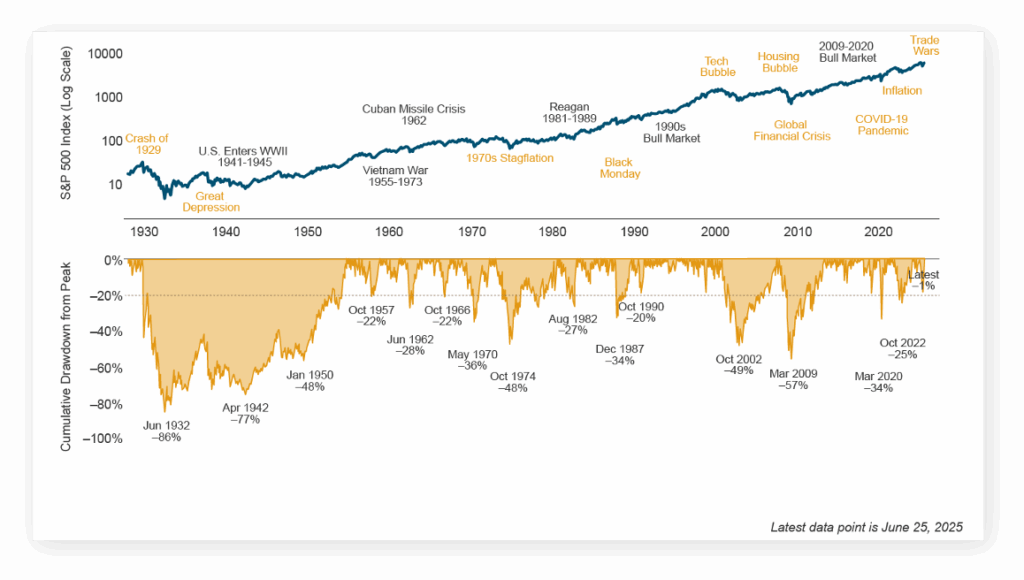
Sources: Clearnomics, Standard & Poor’s
Even within the confines of a single year, the market can swing wildly. The past two decades have seen years when the market ended up in positive territory, but only after rebounding from major drawdowns. Take 2020, for example: That year, the S&P 500 saw a max drawdown of 34 percent before ending the year with 18 percent year-over-year growth. Far from being an outlier, that sort of intra-year rebound is more common than one might think.
Total Returns and Pullbacks
S&P 500 Index total returns. Max drawdown represents the biggest intra-year decline

Sources: Clearnomics, Standard & Poor’s
Why Timing the Market Rarely Works
It’s an understandable temptation: What if you could skip all the bad days in the market and capitalize on the best days? In reality, no one can time the market perfectly. Those who attempt it often end up with less than the patient investor who maintained their position.
Let’s look at another example: What happens to your portfolio if you try to exit the market during a downturn, but end up missing a few of the strongest rebound days? Even just missing five of the best days over a 25-year period would have a significant impact on a hypothetical $1,000 investment. Its growth would be nearly 40 percent lower than that of the investor who stayed in the market.
The cost of missing the market’s best rebound days is steep, and those high-return days often occur in clusters around the worst losses.
Staying Invested: Missing the Best Days
The impact of missing the best market days over the past 25 years
Based on an initial $1,000 investment using S&P 500 returns before transaction costs

Sources: Clearnomics, Standard & Poor’s
A Real-World Example From 2025
We saw this exact story play out earlier this year. In February 2025, the S&P 500 hit an all-time high. Shortly after, however, the Trump administration began imposing and threatening various tariffs on U.S. trading partners that had the potential to radically upend the global economy. The market responded in kind, dropping 19 percent by April 8.
What happened next? The administration decided to pause the most severe tariffs, and the market quickly rebounded. By May 19, the market experienced a 20 percent recovery.
The lesson here is simple: Rather than attempting to time the highs and lows, the more successful tactic is to tailor your investment risk to match your financial objectives. This alignment provides clarity during downturns and helps keep you invested, which is key to capturing long-term gains.
Accepting the Rough Patches
The key to sticking with your investment plan through market turmoil is acceptance. There will be days when your portfolio declines, but your strategy shouldn’t be about making the most of an individual day’s or month’s fluctuations. Rather, it should be about maximizing long-term gains. Your specific strategy and portfolio allocation will depend on your risk tolerance and your long-term goals, but no matter what your financial plan looks like, it should be designed to anticipate volatility. The objective is not to eliminate volatility entirely, but to manage it.
Keep Your Eyes on the Future
Investing in the market is inherently risky, but it’s a risk that has historically been rewarded. Aligning equity exposure with long-term goals, rather than reacting to short-term headlines, is the foundation of a durable investment strategy. The historical record is clear: The patient investor, committed to a disciplined plan, reaps the reward of long-term growth.